Frankie Flores · 3 September 2026
Short-Form Credentials Expand Rapidly Across Eastern Europe and Alter Graduate Employment Pathways
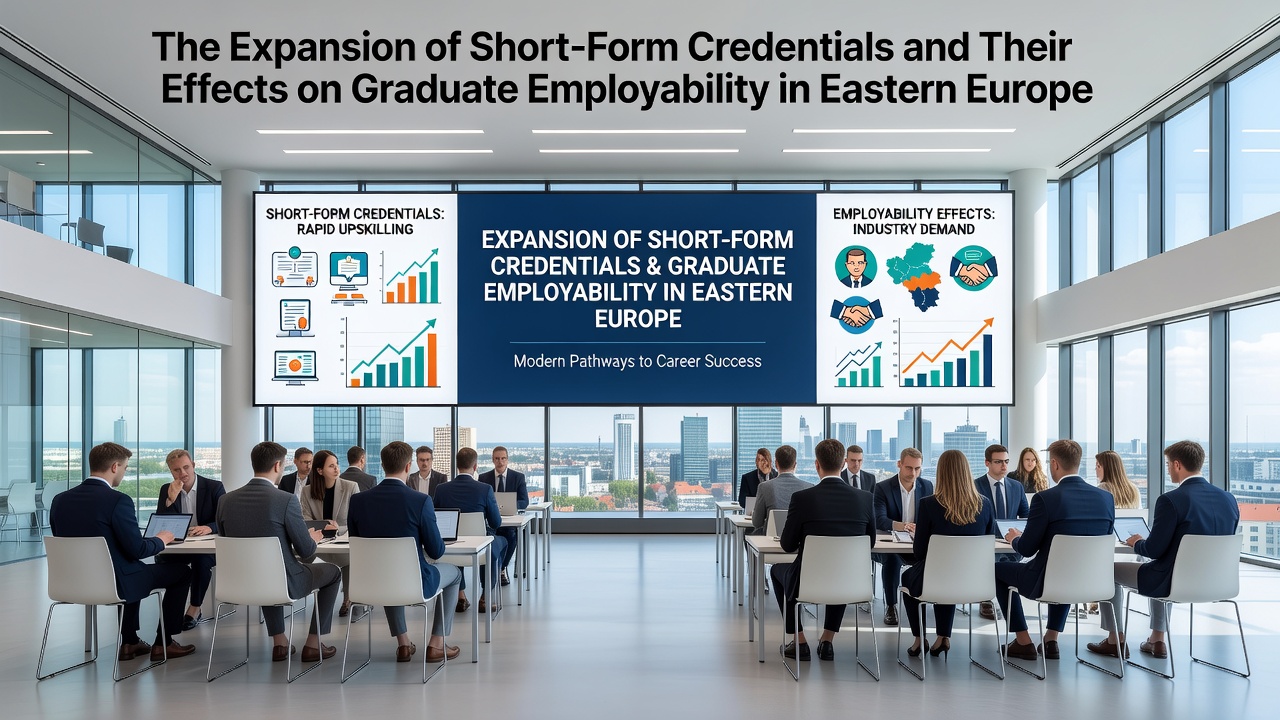
Short-form credentials such as micro-credentials, digital badges, and online certificates have spread through higher education systems in Eastern Europe over the past decade, and data from regional labor market analyses show they now appear on an increasing share of graduate resumes in countries including Poland, Hungary, Romania, and Bulgaria. These compact qualifications typically cover targeted skills in areas like data analysis, digital marketing, and software tools, and they supplement traditional degrees rather than replace them. Observers note that universities and private platforms have partnered to deliver these programs, while enrollment figures rose steadily between 2020 and 2025 according to education ministry statistics from multiple nations.
Regional Adoption Patterns and Enrollment Data
Universities in Poland introduced micro-credential pilots as early as 2018, and similar initiatives followed in Romania and the Czech Republic within two years. Government reports indicate that by 2024 roughly 18 percent of graduates from public institutions in these countries had completed at least one short-form program alongside their main degree. Figures from the European Centre for the Development of Vocational Training reveal that participation rates climbed further in 2025, with online delivery accounting for most new enrollments. Employers in the technology and manufacturing sectors have begun listing these credentials in job postings, particularly when candidates apply for entry-level roles that require specific technical competencies.
Effects on Hiring Outcomes and Skill Alignment
Studies conducted by national statistical offices show mixed yet measurable shifts in graduate employability after short-form credentials entered the picture. In Hungary, a 2024 survey of 2,800 recent graduates found that those holding at least one verified micro-credential secured their first job an average of 1.4 months earlier than peers without such additions. Researchers tracked salary data and observed a modest premium of 6 to 9 percent for graduates who combined a bachelor degree with credentials in high-demand fields such as cybersecurity and supply-chain analytics. Yet the same analyses indicated that credentials unrelated to a graduate field produced little measurable advantage, and employers continued to prioritize core degree completion and internship experience during initial screening.

Industry organizations have responded by updating recruitment frameworks. A report issued by the European Commission in late 2025 documented that 47 percent of surveyed firms in Eastern Europe now accept micro-credentials as supplementary evidence of skill mastery, up from 29 percent in 2022. At the same time, the same document noted that many companies still require formal degree transcripts for roles involving regulatory compliance or advanced research. Those patterns suggest short-form credentials function best as differentiators rather than substitutes within the broader hiring process.
Challenges in Recognition and Quality Assurance
Despite growth, recognition remains uneven across borders and sectors. Some national qualification frameworks have incorporated micro-credentials into their registries, while others continue to treat them as informal learning records. A 2025 working paper from the OECD highlighted that graduates who earned credentials from accredited universities faced fewer verification hurdles than those using commercial platforms. Quality standards also vary, and several ministries have begun pilot audits to assess content rigor and assessment methods. These efforts aim to reduce instances where employers discount credentials due to uncertainty about learning outcomes or assessment integrity.
Developments Expected in September 2026
Education ministries across the region have scheduled a joint conference for September 2026 to review harmonization proposals for micro-credential standards. The meeting will examine options for a shared digital registry and common assessment benchmarks, drawing on data collected through 2025 enrollment cycles. Preliminary agendas indicate discussions will also cover employer feedback collected from manufacturing and IT clusters in Slovakia and Bulgaria. If agreements emerge, updated recognition guidelines could take effect by the following academic year, potentially expanding the pool of credentials that carry formal weight in cross-border hiring.
Conclusion
Short-form credentials continue to integrate into Eastern European higher education and labor markets, with available data showing modest improvements in time-to-employment for graduates who align these qualifications with industry needs. Regional governments and institutions continue to refine recognition processes and quality controls, and the September 2026 policy discussions represent the next step in that ongoing adjustment. Current evidence points to incremental rather than transformative effects on overall graduate outcomes, while patterns of adoption remain strongest in technical and digital skill domains.