
Logan Butler · 15 October 2026
Eastern European Vocational Systems Adopt AI for Personalized Math Micro-Pathways
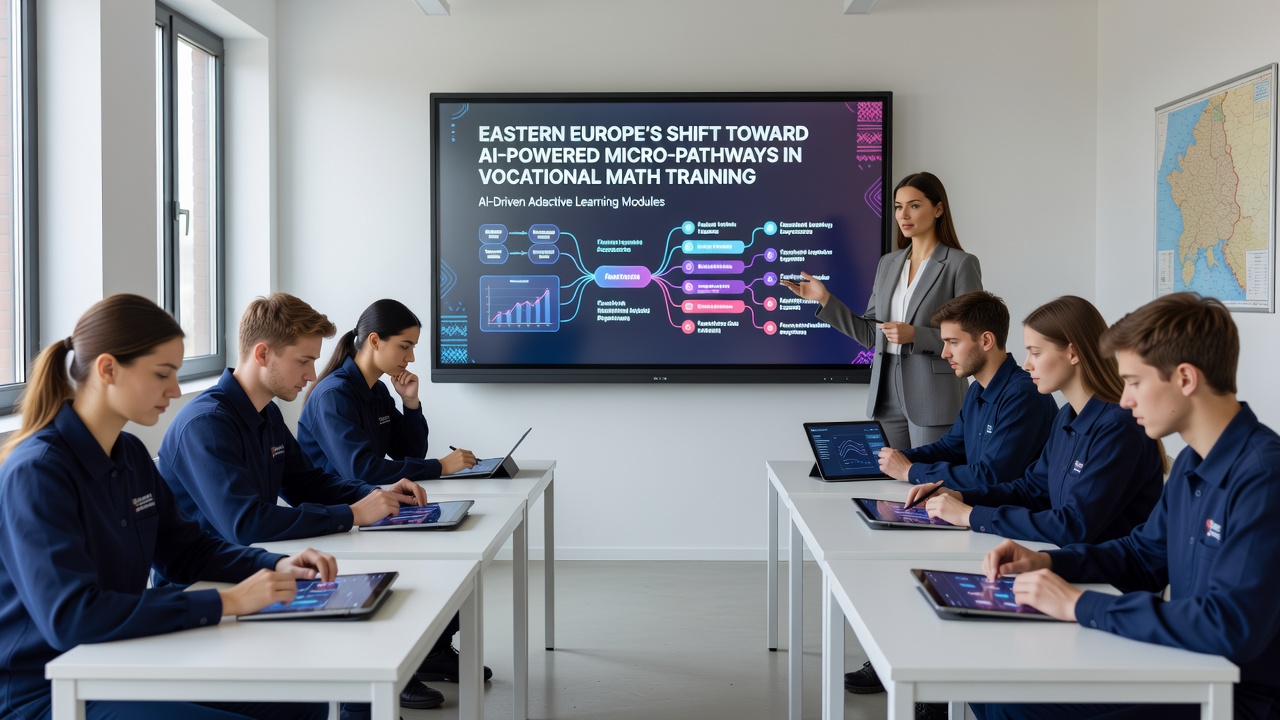
Vocational education networks across Eastern Europe have expanded their use of artificial intelligence to create modular math training sequences that adapt to individual learner progress, and these micro-pathways allow participants to complete targeted skill units rather than full semester courses. Countries including Hungary, Romania, adn the Czech Republic have rolled out pilot programs since 2024 that combine adaptive algorithms with local curriculum standards, while data from regional ministries show enrollment in these short modules grew by 28 percent between 2024 and 2025. The approach breaks traditional math topics such as algebra, statistics, and applied geometry into sequences of 15 to 40 hours each, and completion leads to stackable digital badges recognized by employers in manufacturing, logistics, and technical trades.
Expansion of Modular Credentials in Regional Vocational Networks
Ministries of education in several Eastern European states began aligning micro-pathway frameworks with national qualification systems after 2023 policy updates, and the resulting structure lets training centers deliver math content through AI platforms that adjust difficulty based on real-time performance metrics. Observers note that institutions in Bucharest and Budapest now route students into math modules matched to specific job profiles, whereas earlier models required uniform pacing across entire cohorts. Figures released by the European Centre for the Development of Vocational Training indicate that 14 percent of vocational math instruction in the region used adaptive AI tools by mid-2025, and projections point to further increases following planned infrastructure upgrades scheduled for October 2026.
Technical Features of AI-Driven Math Pathways
Platforms deployed in these programs analyze learner responses to diagnostic tasks and then sequence subsequent modules accordingly, while natural language processing components translate problem sets into local languages without altering mathematical accuracy. Researchers at technical universities in Prague documented how these systems reduce time to proficiency in applied fractions and measurement calculations by an average of 19 percent compared with non-adaptive methods, and similar results emerged from parallel studies conducted in Sofia. The technology also flags common error patterns across cohorts, which allows instructors to insert targeted group sessions only when aggregate data reveal widespread gaps rather than assuming every participant needs the same review.
Employer Integration and Recognition Mechanisms
Manufacturing associations in Slovakia and Poland have begun listing preferred micro-pathway badges in job postings for technician roles, and this shift connects training outputs directly to hiring criteria used by regional plants. Government agencies in the region have established verification portals that employers can query to confirm badge authenticity, while cross-border agreements signed in 2025 enable recognition of credentials earned in one country by companies operating in neighboring states. Data compiled by the OECD education directorate shows that graduates holding at least three math micro-credentials experienced a 12 percent higher placement rate into technical positions than peers completing only traditional diplomas during the 2024-2025 academic year.
Implementation Patterns Observed in 2025-2026
Training centers report that AI platforms require initial calibration periods of four to six weeks before accuracy stabilizes, and staff development programs now include sessions on interpreting dashboard analytics rather than solely delivering lectures. One network spanning three Romanian counties introduced weekly data review meetings where instructors adjust module sequences based on collective learner trajectories, and early results indicate improved retention rates in the statistics unit. October 2026 has been designated for a regional conference hosted by the Hungarian vocational authority to share implementation benchmarks and examine interoperability standards across platforms used in the Czech Republic, Slovakia, and Bulgaria.
Research Findings on Learning Outcomes
Studies conducted by academic teams at universities in Cluj-Napoca and Brno tracked participants over 18 months and found that those progressing through AI-sequenced micro-pathways completed required math competencies at rates comparable to longer traditional courses, yet they entered workplace placements earlier. The same research groups recorded that error rates on standardized applied math assessments dropped by 15 percent after learners finished adaptive modules focused on workplace scenarios such as inventory calculations and tolerance measurements. Reports from the World Bank education program note that these outcomes align with patterns observed in other middle-income economies investing in digital vocational tools, although Eastern European programs emphasize tighter integration with local industry standards than some comparator initiatives.
Conclusion
Eastern European vocational systems continue to refine AI-supported micro-pathways for math training through coordinated policy, platform updates, and employer feedback loops, and the October 2026 conference is expected to set benchmarks for further scaling. Regional data indicate sustained growth in module completion alongside measurable gains in placement metrics, while technical refinements focus on language localization and error-pattern detection. These developments reflect ongoing adjustments in how vocational math instruction connects to labor market demands across the region.